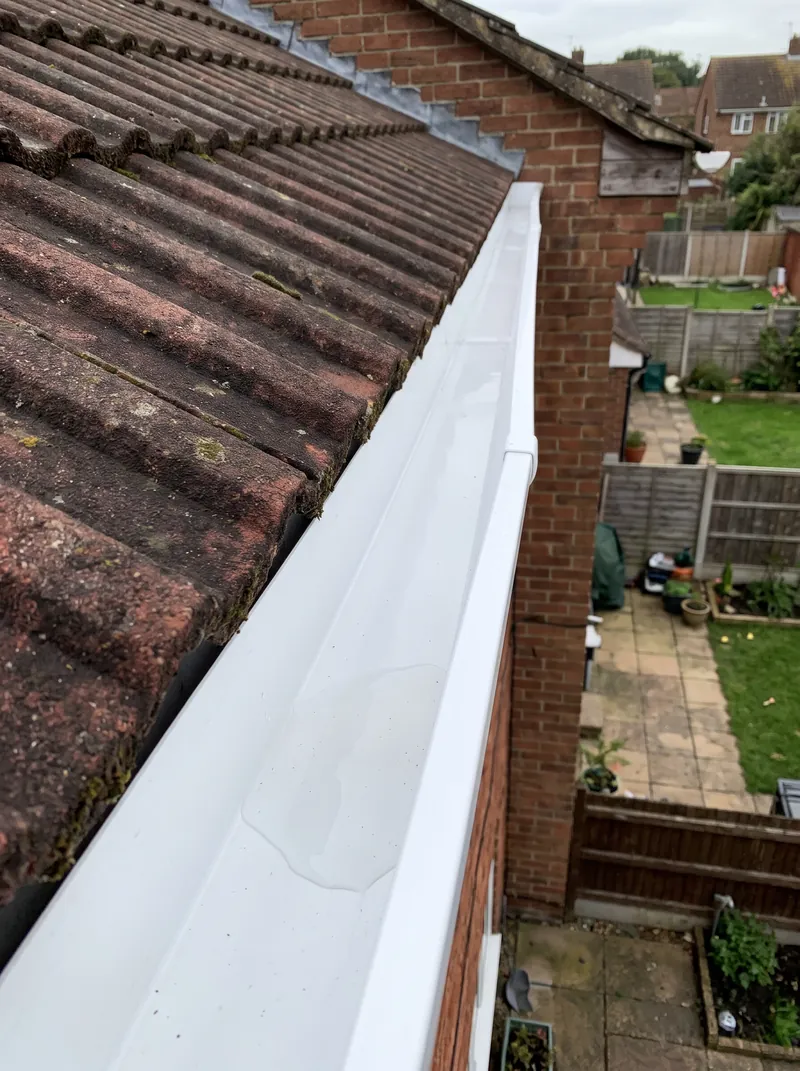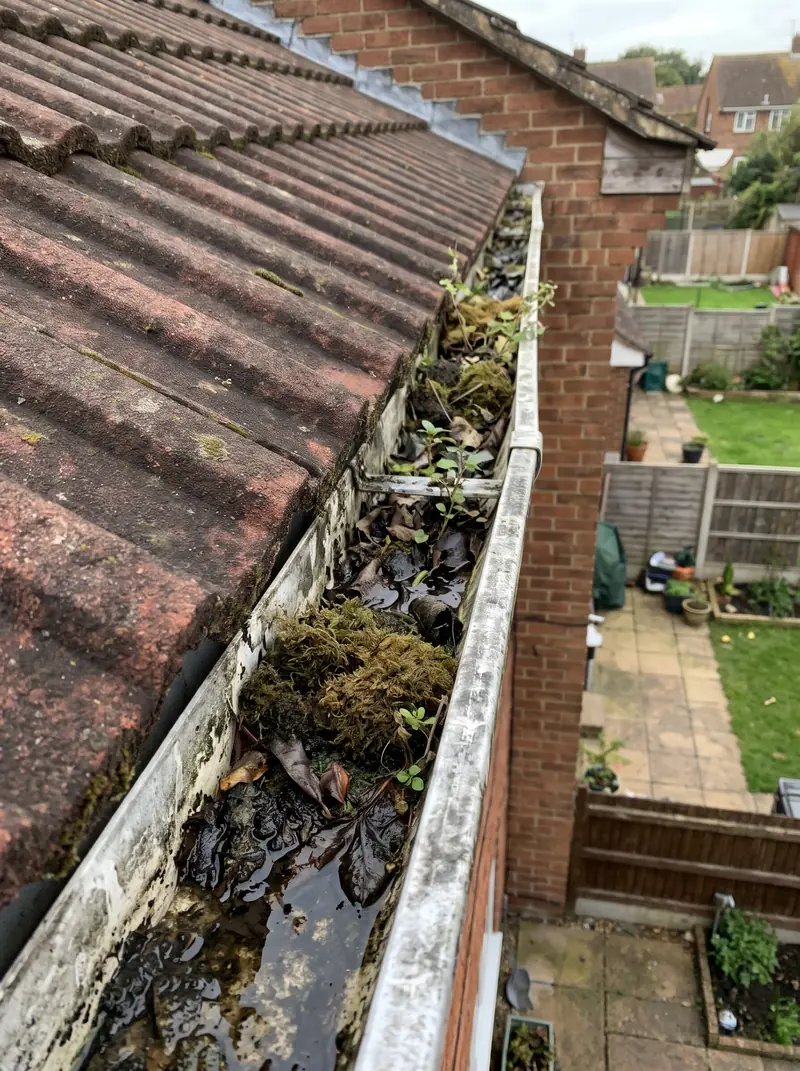
A gutter usually overflows because leaves, moss or silt have blocked the gutter or its outlet, so rainwater can’t reach the downpipe. Less often, the downpipe itself is blocked, the gutter has dropped and slopes the wrong way, a joint has failed, or the gutter is too small for the roof above it.
Is the gutter or outlet blocked?
This is the cause in most cases. Leaves, moss, twigs and roof grit wash along the gutter towards the outlet, the lowest point, where they collect. Over a year they form a plug. Water then backs up along the gutter and spills over the front edge.
From the ground the gutter can look almost empty, because the blockage is sitting right at the outlet. A camera on a pole shows it straight away.
Is the downpipe blocked?
If the gutter overflows right next to the outlet but the gutter looks clear, the downpipe may be blocked. Downpipes are narrow and usually have a bend at the top, called a swan neck, where the pipe tucks back from the gutter to the wall. Leaves and moss wedge there easily. A tennis ball or a bird’s nest is enough to block a pipe completely.
A tell-tale sign is water spilling out of a joint partway down the pipe, or a dry bottom in heavy rain. How to unblock a downpipe explains what you can try.
Is the gutter sloping the wrong way?
Gutters are fitted with a slight fall, a gentle slope towards the downpipe. If a bracket breaks, a section drops or the house settles, the gutter can end up level or sloping away from the outlet. Water then collects at the low point and overflows there, even when the gutter is completely clear.
You can sometimes see this from the ground: the gutter dips in the middle, or water sits in it for days after rain. This needs the brackets adjusted or replaced, which is a job for a gutter fitter.
Is a joint leaking rather than overflowing?
Water dripping from a single point, rather than pouring over the edge, is often a failed joint. Plastic gutters are joined with rubber seals that harden and crack with age. That’s a leak, not an overflow, though the two often happen together because a blocked gutter holds water against the joints. Why is my gutter leaking at the joints?
Is the gutter too small for the roof?
A large roof area, or a steep roof that sends water down fast, can overwhelm a small gutter in a cloudburst. Water shoots over the gutter at the bottom of the roof slope, especially in a valley where two roofs meet. This tends to happen only in the heaviest rain. Deeper gutters or extra downpipes can help.
Is water overshooting the gutter?
On some roofs, especially steep ones or where the tiles stick out a long way, water in a heavy storm runs off the roof fast enough to shoot straight over the gutter. If the gutter is clear and the overflow only happens in torrential rain, this may be the cause.
Is the problem at a valley or a corner?
Where two roof slopes meet, water and debris from both end up in the same part of the gutter. Corners and valleys overflow first because they collect the most. They’re also hard to see from the ground. We always check these with the camera.
How do I find out which cause it is?
The quickest way is to look inside the gutter, which is hard from the ground without a camera. When we visit, we:
- Look inside with the inspection camera before touching anything
- Clear the gutter and outlets with the vacuum
- Run water along the gutter and down each pipe
- Watch where it goes
If water flows freely, it was a blockage. If it still pools or spills, we can usually see why on the camera, and we’ll tell you.
Does an overflowing gutter need sorting quickly?
It isn’t an emergency, but it shouldn’t wait months. Each storm puts water on the same patch of wall, soaking brickwork, softening mortar and sometimes pushing damp through. Overflow onto a path makes it slippery and green. Overflow near a door can bring water inside.
Can I stop it overflowing myself?
If it’s a bungalow and you’re safe on a ladder, you can clear the outlet by hand. Don’t lean the ladder on the gutter, and wear gloves. For anything higher, it’s safer to get it cleared from the ground. Our gutter cleaning includes the camera check and a water test.
Why does my gutter only overflow in one spot?
Because water finds the lowest point. If a gutter overflows at a single spot every storm, that spot is either right by a blocked outlet, a low point where the gutter has sagged, or a corner where two roof slopes send water into the same place. Mark the spot from the ground and tell us when you book: it saves time and tells us where to point the camera first.
Why does my gutter overflow even though it was cleaned last year?
A few possibilities. Trees may have dropped more than usual, the roof may be shedding moss, or the downpipe may have been missed. Sometimes a gutter was only cleared where it could be reached from a ladder, leaving outlets and corners full. And sometimes the cause was never a blockage at all, but a gutter that falls the wrong way. Looking inside with a camera is the quickest way to tell.