Most homes need their gutters cleaned once a year, ideally in late autumn after the leaves have fallen. Houses under large trees, near woodland or with moss on the roof usually need it twice a year, in late autumn and again in spring. Newer homes with no trees nearby can sometimes go eighteen months to two years.
Why is once a year the usual answer?
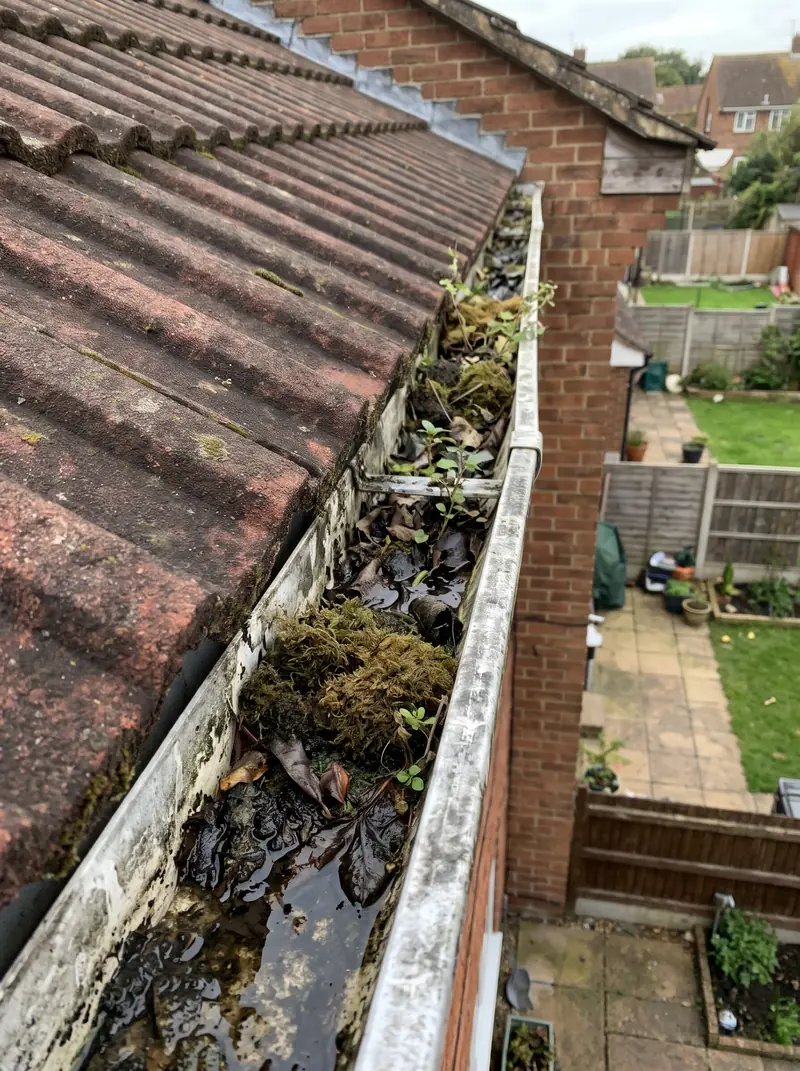
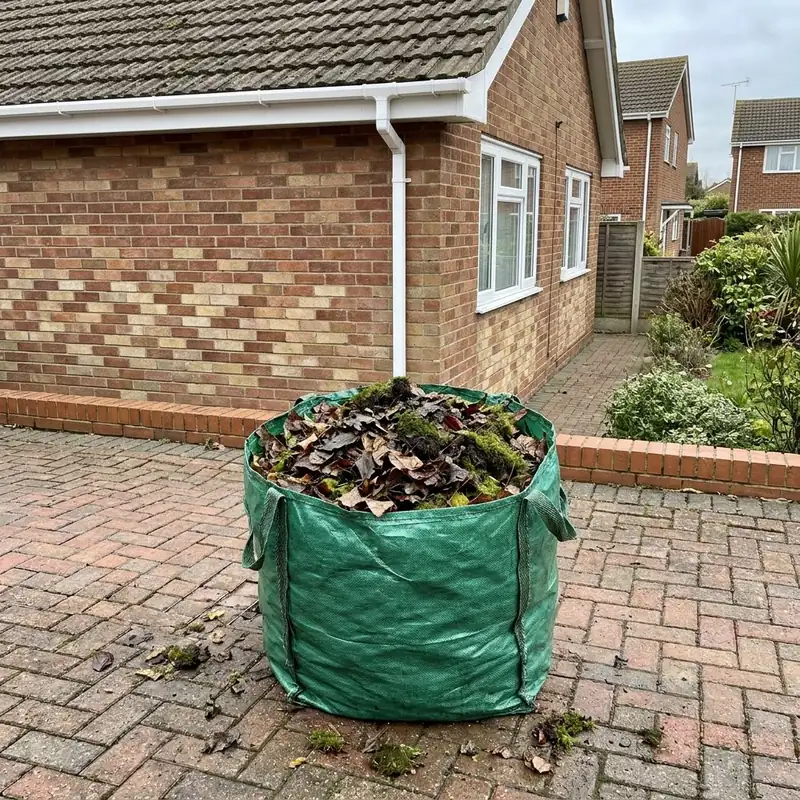
Because one autumn of leaves, plus a year of moss and roof grit, is roughly what it takes to fill the outlets of an average gutter. The gutter itself rarely fills from end to end. What happens is that debris washes along to the outlet, the lowest point, and builds up into a plug. Once the outlet is blocked, water backs up and spills over the front edge, even if the rest of the gutter looks fairly empty from the ground.
Cleaning once a year, after the trees have dropped their leaves, clears that build-up before the wettest part of winter. That’s why late November and December are the busiest weeks for gutter cleaning in Essex.
Which homes need cleaning twice a year?
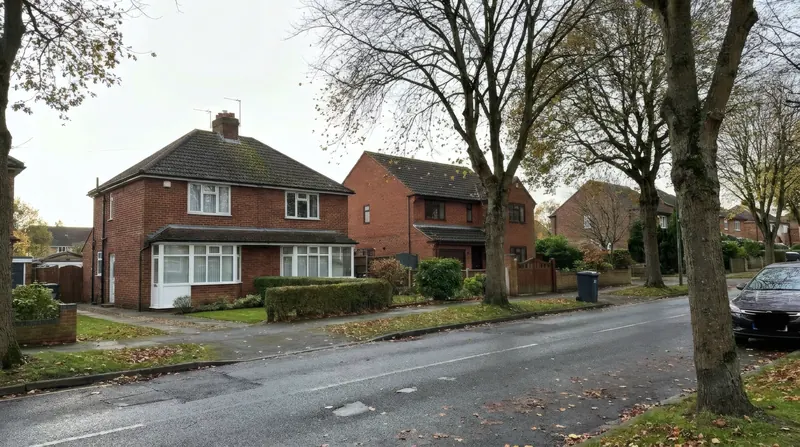
The big factor is trees. If there are mature trees within a few metres of the roof, especially oak, sycamore, beech, horse chestnut or willow, the gutters will fill much faster. Trees don’t only drop leaves in autumn; they drop catkins, seeds, blossom and twigs in spring and summer too. Sycamore seeds are particularly bad because they germinate in the wet silt and grow into small plants.
The second factor is moss. A concrete-tiled roof with a good coat of moss sheds clumps of it into the gutter every time it rains heavily, all year round. Moss is dense and holds water, and it blocks outlets quickly.
Homes that usually need two cleans a year:
- Houses backing onto woods, parks or commons, like those near Hockley Woods, Norsey Wood or Epping Forest
- Bungalows under tall garden trees or hedges
- Homes with mossy north-facing roofs
- Houses where gulls or pigeons nest on the roof
Can some homes go longer between cleans?
Yes. A newer house on an open estate with no nearby trees, a clean roof and a decent gutter fall might go eighteen months or more. The only way to know is to look, which is hard from the ground. A quick camera check tells you whether the outlets are starting to fill.
We’d rather tell someone their gutters don’t need doing yet than clean an empty gutter. If the camera shows they’re clear, we say so.
What are the signs gutters need cleaning now?
Don’t wait for a calendar date if you see any of these:
- Water spilling over the front of the gutter in rain
- A downpipe that stays dry, or only dribbles, in heavy rain
- Plants or grass growing out of the gutter
- Green or black streaks down the fascia or wall
- A damp patch inside on an upstairs wall or ceiling corner
- Water dripping from the joints between gutter sections
Any one of these means water isn’t getting away. Signs your gutters are blocked covers each sign in more detail.
Does the type of gutter make a difference?
A little. Most Essex homes have plastic half-round or square gutters, which are smooth and fairly easy to clear. Older houses may still have cast-iron gutters, which are rougher inside and hold silt more. Box gutters and valley gutters, where two roofs meet, collect debris from two slopes and often need checking more often than the main runs.
Gutter size matters too. A small gutter on a large roof fills faster and overflows more easily than a deep one, so it has less room for any build-up.
Does the weather in Essex change how often gutters need doing?
Essex is one of the drier counties in England, so gutters here don’t get flushed through by rain as often as in the west. That means leaves and silt sit in the gutter longer and compact into a dense layer. When a heavy storm does come, the gutter overflows because the outlet is already half blocked.
Coastal towns like Southend, Canvey, Clacton and Maldon get more wind and gulls. Wind blows leaves from neighbouring gardens into gutters, and gulls add nesting material. Inland towns near woods get more leaf fall.
Is it worth cleaning gutters if they look fine?
From the ground, gutters often look fine when they aren’t. You can’t see inside them, and the build-up sits at the bottom. A gutter can be half full of silt with nothing poking over the edge. The first visible sign is often an overflow in a storm, by which point the wall below is getting soaked.
That’s why we use an inspection camera. It shows the inside of the gutter on a screen, so you can decide based on what’s actually there.
What happens if I leave it for years?
The silt and moss compact into a heavy, wet mat. Grass and seedlings take root. The weight pulls on brackets and can make the gutter sag, which stops it draining even after cleaning. Water spills over in the same place every storm, soaking brickwork and fascias. Fixing that damage costs far more than an annual clean. What happens if you don’t clean gutters explains the knock-on effects.
Should I clean my gutters myself?
Bungalow gutters can be cleared by hand with care, using a stable ladder, gloves and a scoop, but never lean the ladder on a plastic gutter. Two-storey gutters are a different matter. Ladder falls are one of the most common causes of serious injury at home, and you still won’t easily see whether the outlet and downpipe are clear.
We clear gutters from the ground with a vacuum on long poles and check them with a camera. Our gutter cleaning page shows the prices and what’s included.
What’s the simplest plan for most homes?
Book a clean once a year, in late autumn. If you have big trees nearby or a mossy roof, add a spring clean. In between, look out for the signs above after heavy rain. That’s enough to keep the water going where it should for most Essex houses.