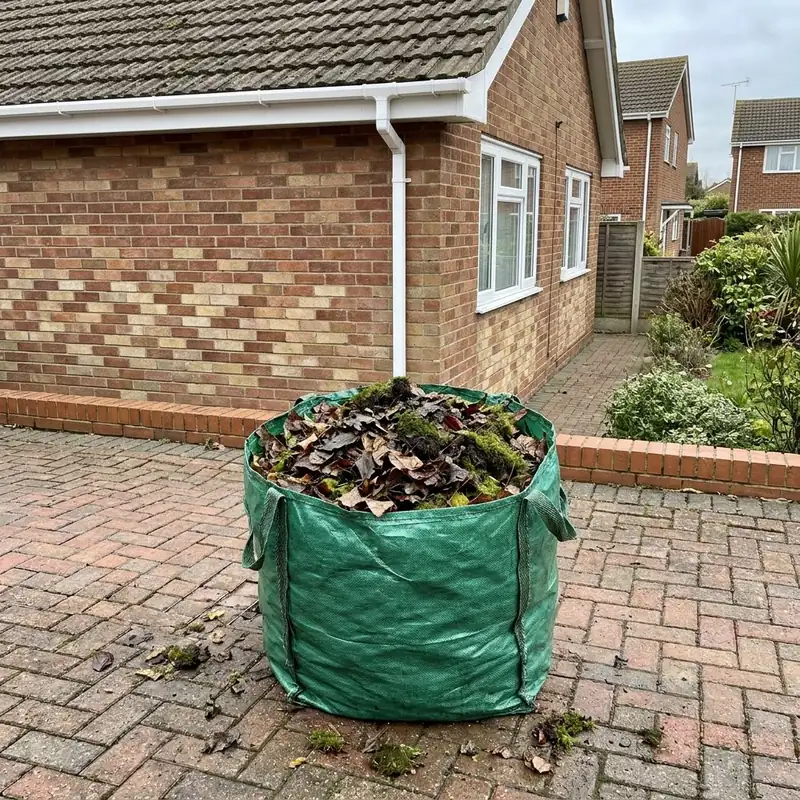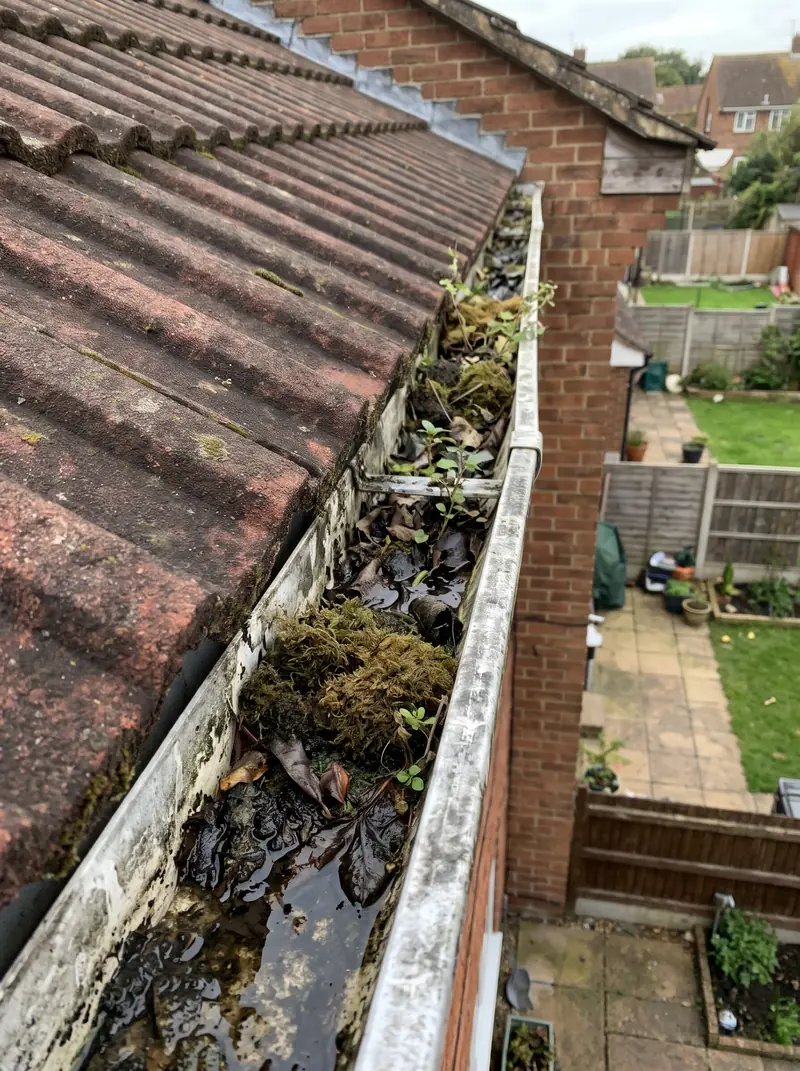
The clearest signs of blocked gutters are water spilling over the edge in rain, a downpipe that stays dry in a downpour, plants growing out of the gutter, green streaks down the fascia or wall, and damp patches inside near the ceiling. Any one of these means rainwater isn’t getting away.
Is water spilling over the front of the gutter?
This is the most obvious sign. In heavy rain, look along the gutters. If water is pouring over the front edge instead of running into the downpipe, something is stopping it. Usually it’s a build-up of leaves and silt at the outlet, the point where the gutter joins the downpipe.
Notice where it overflows. If it’s right next to the downpipe, the outlet or pipe is probably blocked. If it’s at the far end from the downpipe, the gutter may have dropped and be running the wrong way, which is a fitting problem rather than a blockage. If it’s along the whole length, the gutter is full or too small for the roof.
Is the downpipe dry in heavy rain?
In a proper downpour, every downpipe should have water rushing out at the bottom. If one stays dry or only dribbles while it’s pouring, the water isn’t reaching it. Either the gutter above is blocked before the outlet, or the downpipe itself is blocked, often at the swan neck bend at the top.
A gurgling or bubbling noise from the pipe can also mean a partial blockage.
Are plants growing in the gutter?
Grass, moss, weeds or even small tree seedlings poking out of a gutter mean there’s enough soil-like silt in there for things to grow. That’s a sign the gutter hasn’t been cleared for some time. Roots bind the silt into a solid mat that water can’t get through, and the extra weight pulls the gutter down.
Are there streaks down the fascia or wall?
Green or black stripes running down the white fascia board, or dark streaks on the brickwork below the gutter, show where water regularly runs over the edge. Green is algae growing where the surface stays wet. Black is dirt carried by the water. These streaks often appear before you ever see an overflow, because the overflow happens at night or when you’re out.
Is there damp inside the house?
A damp patch high on an inside wall, especially in a corner or near the ceiling of an upstairs room, can come from an overflowing gutter outside. The wall below the overflow gets soaked every time it rains, and the damp works through. Bubbling paint, mould spots or a musty smell in one corner are all worth checking against what the gutter is doing outside.
Not every damp patch is a gutter, but it’s one of the cheapest causes to rule out.
Is the gutter sagging or pulling away?
A gutter full of wet silt is heavy. Over time the brackets bend and the gutter dips. Look along the line of the gutter from a distance: it should be straight with a slight fall towards the downpipe. A visible sag, or a gutter that has pulled away from the fascia, often means it has been full for a long time.
Is there water pooling at the base of the wall?
Overflowing water lands in the same spot every storm. You may see a muddy patch in a flower bed, a green slippery stretch of path, soil washed away from the base of the wall or a puddle by the back door. Water collecting against the base of a wall is bad for the brickwork and the damp-proof course.
Are birds, insects or vermin visiting the gutter?
Birds picking at the gutter, or a lot of insects around it in summer, can mean standing water and rotting debris. Pigeons and gulls sometimes nest in or near gutters, which adds even more material. If birds are nesting, the nest is protected while it’s in use, so the gutter has to wait. Birds nesting in gutters explains the rules.
What should I do if I spot these signs?
Get the gutters checked and cleared before the next spell of heavy rain. If you’re in a bungalow and comfortable on a ladder, you can look in yourself, but don’t lean the ladder on the gutter. For two-storey houses, it’s safer and quicker to have them cleared from the ground.
When we clear gutters, we look inside with an inspection camera first, so you can see exactly what was blocking them. Then we vacuum them out, test the outlets with water and photograph the clean gutter. See what’s included.
Could it be something other than a blockage?
Sometimes. A gutter that overflows even when it’s empty may be:
- Running the wrong way. If brackets have moved, the gutter can slope away from the downpipe.
- Leaking at the joints. Old seals between sections fail, and water drips through. Why is my gutter leaking at the joints?
- Too small. A large roof can send more water than a small gutter can carry in a cloudburst.
- Missing a piece. A stop end or an outlet can come loose.
The camera check shows these too. If it’s not a blockage, we tell you what we see so you can get the right person in.
When is the best time to look for these signs?
During or just after heavy rain. Walk round the house with an umbrella and look at each gutter and each downpipe in turn. Overflow, dry pipes and drips are all obvious when water is moving, and invisible on a dry day. Late autumn, after the leaves fall, is the moment most gutters tip over from coping to overflowing, so that’s the time to be watching.